You are here: Products / Hardware / Optii / Trouble Shooting
English
Deutsch
¬Social Bookmarks 
digg.comFurlgoogle.comstumbleupon.com

This section should help fixing problems, which may occur during operation of the device.


I2C lines are permanently low without any active external device (I2C lines are high if Optii is not connected)

  • Are both sides powered with a voltage between 1.5 V and 5.5 V?
  • Do both buses deliver the required supply current?
  • Is the pinning of the cables correct?
  • Are the connectors plugged in correctly?

I2C signals are not transmitted to the other bus

The external device is not able to pull down the lines(s) lower than the reference voltage Uref.

  • Serial resistances on the bus are too high
  • The pull-up resistors are too low

Figure 1 shows a simplified schematic of the I2C bus (only SCL shown). Assuming Tracii XL pulls down the line as an external device, the serial resistor Rs and the pull-up resistor Rp work as a voltage divider. A high value of Rs results in a high remaining voltage U2. If this voltage U2 does not fall below Uref, Optii is not able to detect the active device.

For proper operation, a serial resistance Rs of 0 Ohm would be the best. If a decrease of the serial resistance is impossible, increasing the pull-up resistor Rp will also enhance the situation, but may limit the maximum transfer speed.

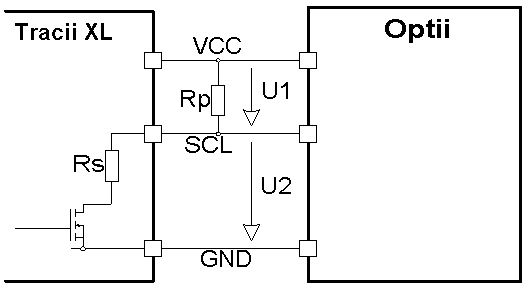
Figure 1 Problem of Serial Resistances

I2C signals are not transmitted properly to the other bus: Too small signal width, e.g. SCL signals do not arise up to the supply voltage Vcc

  • Bus capacitance is too high
  • Lower pull-up resistors (considering the difficulty with serial resistances)

Spikes on the I2C signals

  • Lower serial resistances (low signals of external devices should clearly fall below the reference voltage Uref)
  • Increase the value of pull-up resistors Rp
 
www.telos.de