
Tracii 400
telos Tracii 400 – Fast Mode I2C Monitor and Interface
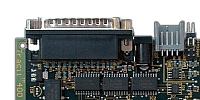 Tracii 400 (it reads Tracy 400) is a hardware-based 400 kbit/s full-speed I2C bus interface featuring the I2C modes mult-master and even as I2C slave. Additionally Tracii comes with powerful I2C analysing facilities.
Tracii 400 communicates with the PC via a standard bi-directional printer port in EPP mode. In case you notebook does not have one consider using our Cardbus adapter.
Tracii 400 is designed as a high end I2C tracing appliance, thus, no compromises have been made. To maximise
performance, Tracii has no microcontroller. Instead, all functions are directly implemented in silicon using an ASIC.
If you are looking for a more sophisticated, USB based Tracer, please check
Tracii XL 2.0.
- Tracii 400 interfaces your PC to the I2C bus.
- I2C Bus protocol according to the I2C-Bus specification for
standard– and fast-mode. Bitrates can be set by software between 123
bit/s and 800 kbit/s. Of course rates exceeding 400 kbit/s are not defined in the I2C specification for fast-mode.
However for test-purposes it is convenient to have the change running the bus at a higher rate. Please be aware of the decreasing signal quality in this case. - I2C modes single-master, multi-master, slave and tracer.
Tracii 400 is always in one of the above modes. The mode can easily be altered software-controlled. - TWI bus support
I2C Tracer
- I2C traffic is logged to the local on-board memory. With the help of hard- and software filter the stored messages can be limited to the interesting ones.
- Since I2C logging is done in hardware Tracii’s tracing capabilites are superior to all software based solutions.
Even for 400 kbit/s all the I2C traffic is logged without slowing down the bus as long as the 64 kByte local buffer is not filled up. Thus, the I2C clock is not stretched except for the unlikely event of a buffer overflow. - Time stamps are available, each and every message byte has a time value. Thus, you do no only see the order of the messages, you have the actual timing at your fingertips.
- Trigger output for the I2C bus conditions start, stop, ack and for the error condition frame error. This, you have a good chance to show the event you are interested in on your oscilloscope triggered by Tracii 400. In case you want an I2C tracer with analog tracing capabilities maybe you should consider using Tracii XL 2.0.
- A hardware filter checks I2C events locally, thus, the total number of messages send to the PC can be reduced.
- To use Tracii 400 as a tracer you either need the application TraciiSpy or the library
TraciiWork. Both are sold separately.
- Tracii 400 is able to act as an I2C slave. You can write you applications on your PC using the Tracii 400 access library
TraciiWork which includes support for C, C++, Microsoft Visual Basic and Java. - Due to the parallel port hardware connection between Tracii 400 and your PC you can respond quickly to the events occuring on your I2C Bus
- 64 kByte on-board memory for buffering data from and to PC / I2C-Bus. This buffer is used for sending and tracing activities. It can be written and read simultaneously.
- 7 and 10 bit addressing
- Several I2C termination values are selectable including an active termination.
- Tracii 400 supports 5 volt I2C buses directly. Additionally we offer solutions for a wider range. Please have a look at our level shifter product Levii. By combining Tracii 400 with Levii the supported voltage range goes down to even 1.8
volt. - 10 by 10 cm sized board inside a plastic housing. 4 pin 2.5 mm Stocko
connector for I2C with centred power. - There are two ways to supply the board: Either by unregulated 8 – 9 volt through a standard DC connector or by regulated 5 volt via the I2C power lines.
- Several software packages available for transmitting, tracing and custom application development.
- The Tracii 400 access library TraciiWork includes support for C, C++, Microsoft Visual Basic and Java.
- Labview VIs
- Tracii 400 comes without cables / power supply.
| tracii400um.pdf
Usermanual |
426 K |
Order
This is an expired product. It cannot be ordered anymore